“What is there to see if we put down the phone- which makes us deserve to go blind, considering that we no longer know how to see?” writes journalist Etienne Dumont in Swiss paper Bilan[1].
I’ve often wondered the same – as I take the morning train to work, I peer up from my phone or book to look out at stone aqueduct towering over the Point de la Jonction, where the Rhone and Arve rivers converge, mixing shades of turquoise. What strikes me is how daily commuters, perhaps coffee-deprived, look absorbed in their own algorithm-shaped worlds. I often wonder what the long-term effects of scrolling will do for our generation – with early onset arthritis, hunched backs, and exceedingly low attention spans.
It’s a strange way to live – creating content for social media while making a conscious effort to experience life at a slower pace.
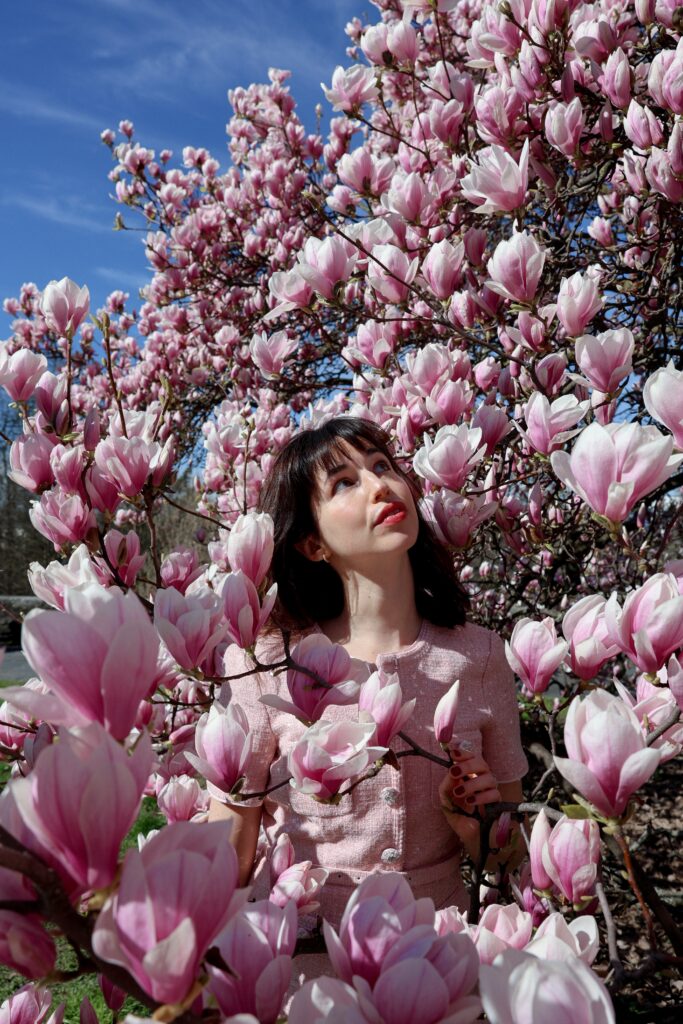
The overcast skies that once loomed over Lac Léman have given way to blush-toned magnolias and powder-pink cherry blossoms dotting the city — a gentle reminder to pause, look up, and perhaps even stop scrolling long enough to smell the flowers.
Luring tourists each spring to Japan, these blossoms serve more than a pretty backdrop for a photo. In bloom for approximately two weeks, beauty is short-lived, reminding us to cherish the present moment, and life while we have it. And while I dream of traveling to Japan to see blossoming sakura one day, for now I enjoy seeing nature’s wonders closer to home. Below are a few local favorites to witness Geneva in bloom:
- Palais Eynard
- Jardin Botanique
- Agrippa-d’Aubigné Terrace
- Parc la Grange
- Parc de l’Ariana
Palais Eynard
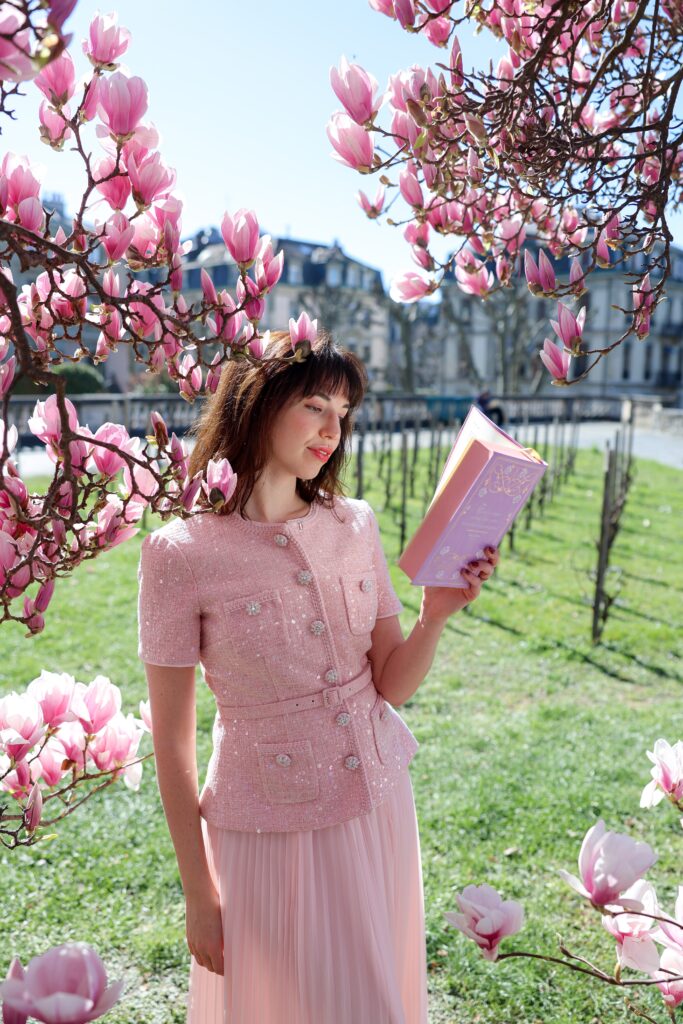
While the Palais Eynard holds daily meetings of the City of Geneva’s government officials and occasional wedding reception, locals recognize as holding the most beautiful magnolia tree in the city.
A young mother poses next to her waddling toddler beneath baby pink magnolia leaves, while another woman leans over a stone railing, her large glasses descending her nose as she eagerly sketches the overarching magnolia in a notebook. The space on a Friday morning flows with tourists, cameras filming like foreign correspondents capturing this fast-lived phenomenon.
“Just look how quickly the leaves fall,” said Geneva-based photographer Alina Sergeichuk, picking up a blossom from the ground, sharing with me to add to my hair for a spontaneous photoshoot I booked, for no particular reason but to capture this moment for my future self.
Sensitive to the slightest gust of wind and subtle spring rainfall, magnolia blossoms are short lived – peaking in late-March to early April, never staying more than one or two weeks.
Jardin Botanique
“Stick your finger here,” my colleague Miram joked as we passed Venus flytraps at the Geneva botanical garden. She stuck a small twig into what appeared a small red mouth, it’s yellow teeth slowly sinking into the bark, a more innocent looking villain than what I’d seen in Little Shop of Horrors.
The Geneva Botanical Garden was founded in 1817 but moved to its location on the quieter side of the lake in 1904. Conveniently located in front of my desk job, I often stroll here during my lunch break. My favorite spot is a bench in front of the deer, located next to a small pond where wades a black swan (turns out it’s not just a ballet film starring Natalie Portman) and family of flamingos.
The gardens pride themselves on serving as an international reference in botany, making scientific activities and learning accessible to those lacking green thumbs.
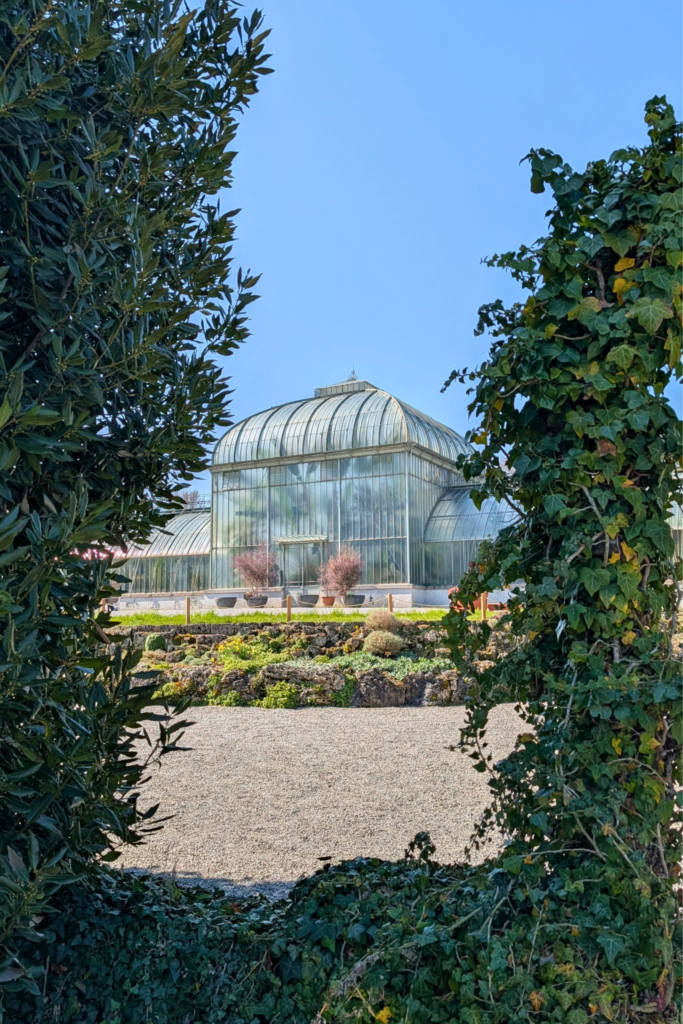
A personal highlight was in the garden’s winter garden, a glass dome reflecting pink and green reflections, resembling the inside of a kaleidoscope, where the giant spear lily blossomed after 43 years, blooming only once in its lifetime.
Agrippa-d’Aubigné Terrace
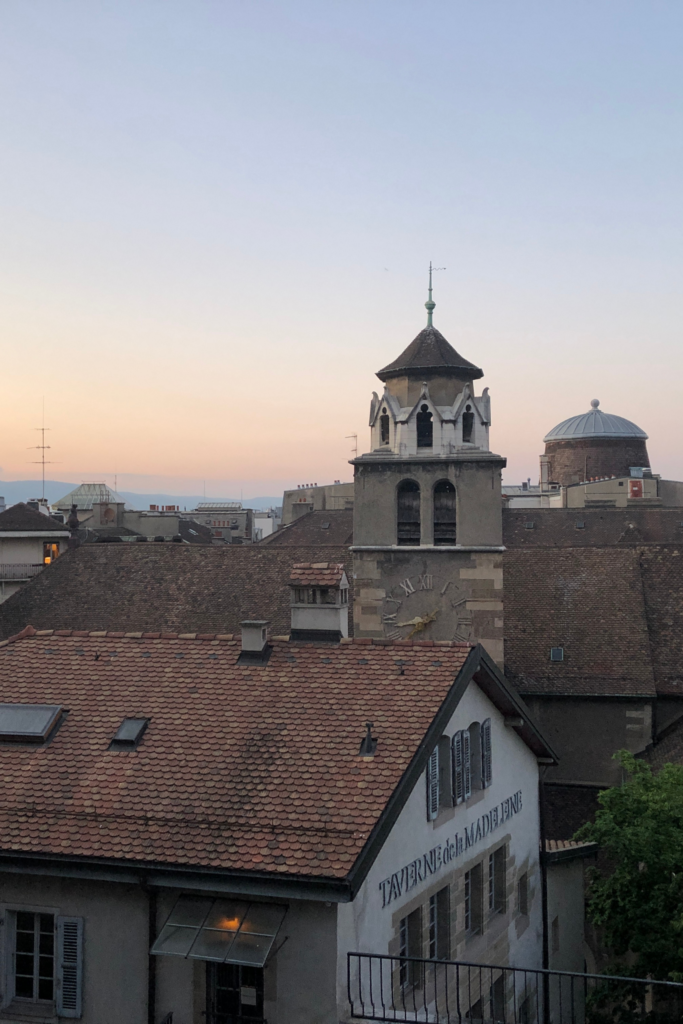
The church bells ring from Saint Pierre’s Cathedral as the morning sun peers through cherry blossoms on the Agrippa-d’Aubigné Terrace. A picnic table sprinkled with fallen flowers is occupied by a woman reading, overlooking the rooftops from the Old Town ahead, an overlooked spot for one of the best views of the jet d’eau in the city.
The intimate space is filled with historic oddities, including a former bunker below and a stone cannonball still embedded in the wall, as though it had fallen from the sky. Despite Switzerland’s historic neutrality, this shelter was built in 1939 as a “just in case” measure while war unfolded in neighboring countries. It could accommodate up to 1,200 people and was thankfully never used for its intended purpose. Instead, it later became a cultural center linked to the neighboring Protestant church — hosting knitting circles, book clubs, senior dance classes, and choir concerts.
A small staircase is home to three wall-sized works with mythological gods pieced together with mosaic tiles. Once a mecca for protestants, seeing larger than life mythological gods is curious. The art is the result of a contest held in 1947, in which artist Marcel Poncet won for his personification of the Rhone and Arve rivers, gods to glorify the city’s bodies of water, standing proudly next to Neptune, god of the sea.
Parc la Grange
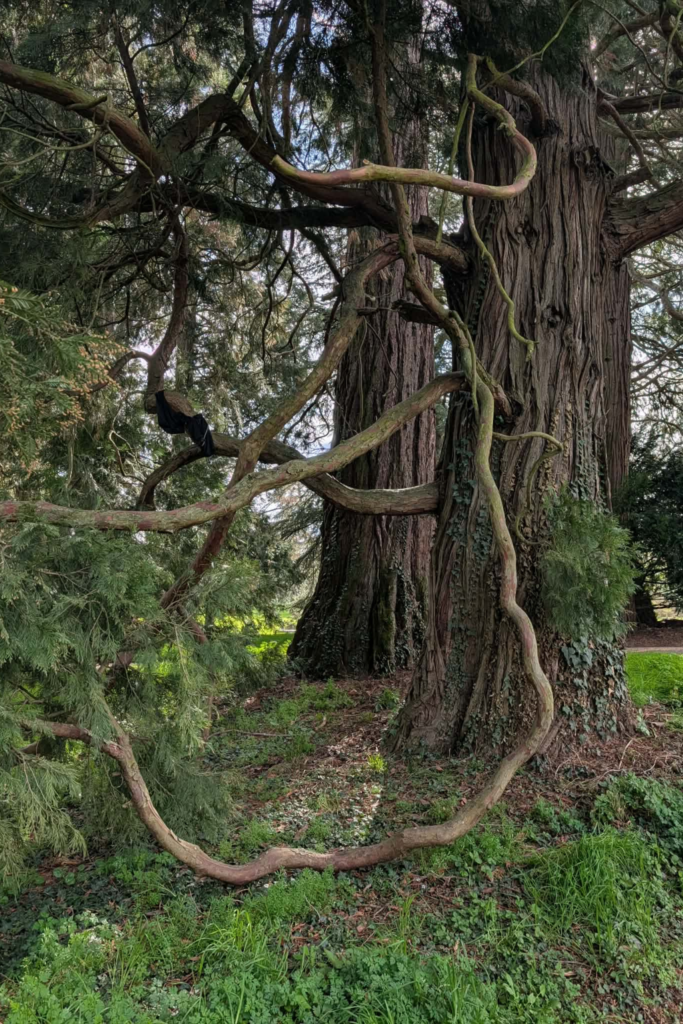
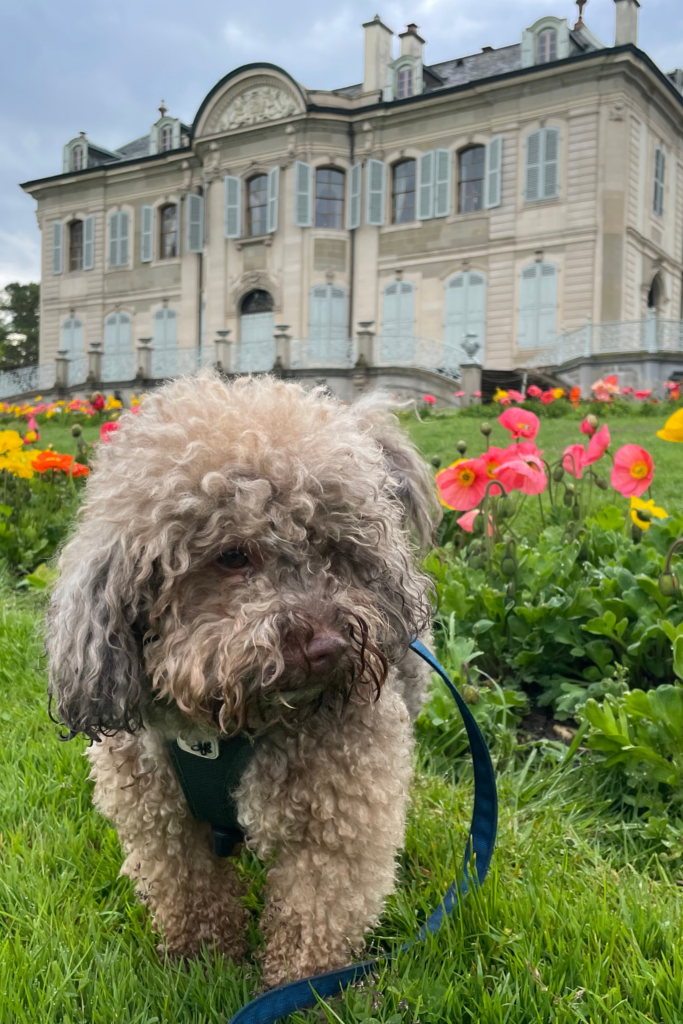
I still remember standing at the end of our street, leaning over a metal barrier, as Vladimir Putin’s presidential motorcade zipped by. Police lined the street while a helicopter circled above swans and ducks drifting across the still lake. In June 2021, the city seemed to close in on itself to welcome leaders of opposing powers — the United States and Russia — for a summit held in the historic villa at Parc La Grange.
The meeting ended earlier than expected, concluding with an ironic echo of the 1985 Reagan–Gorbachev Geneva statement: that a nuclear war cannot be won and must never be fought.
Bequeathed to the city of Geneva in 1918, the park is now one of the city’s most idyllic picnic spots, offering panoramic views across the lake. Its rose garden, planted in 1945, is home to some 12,000 roses across 200 varieties, making it one of the most beautiful places in Geneva in early summer.
In warmer months, the Scène Ella Fitzgerald hosts free concerts several times a week (yes, this is not some elaborate April Fool’s joke). Just beside it sits Théâtre de l’Orangerie, an outdoor vegan restaurant and a gravel court where locals gather to play pétanque.
Parc de l’Ariana
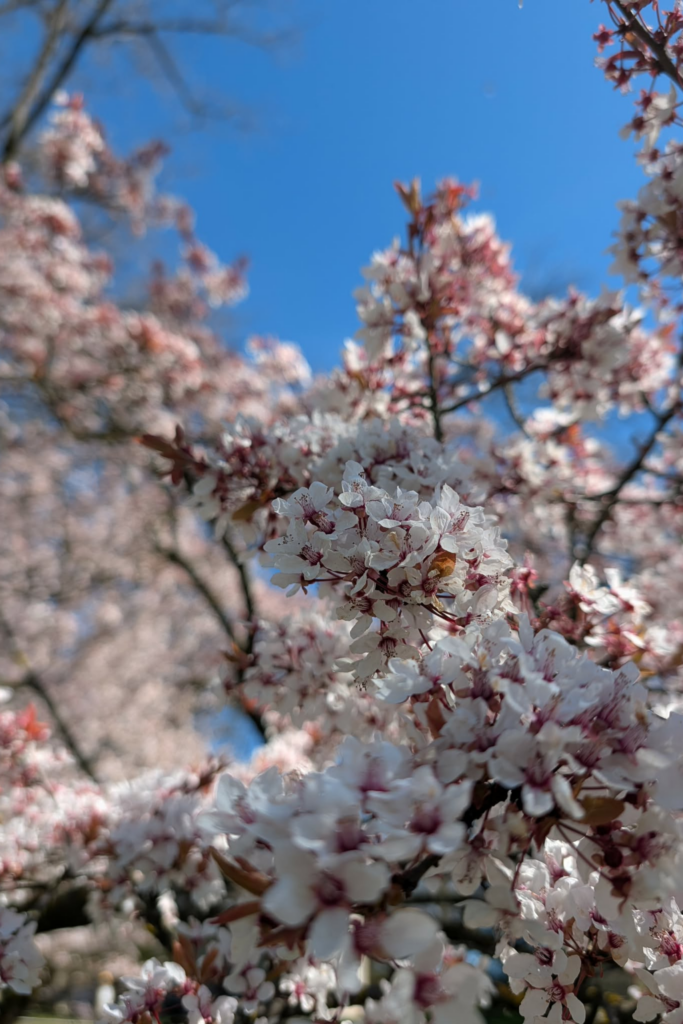
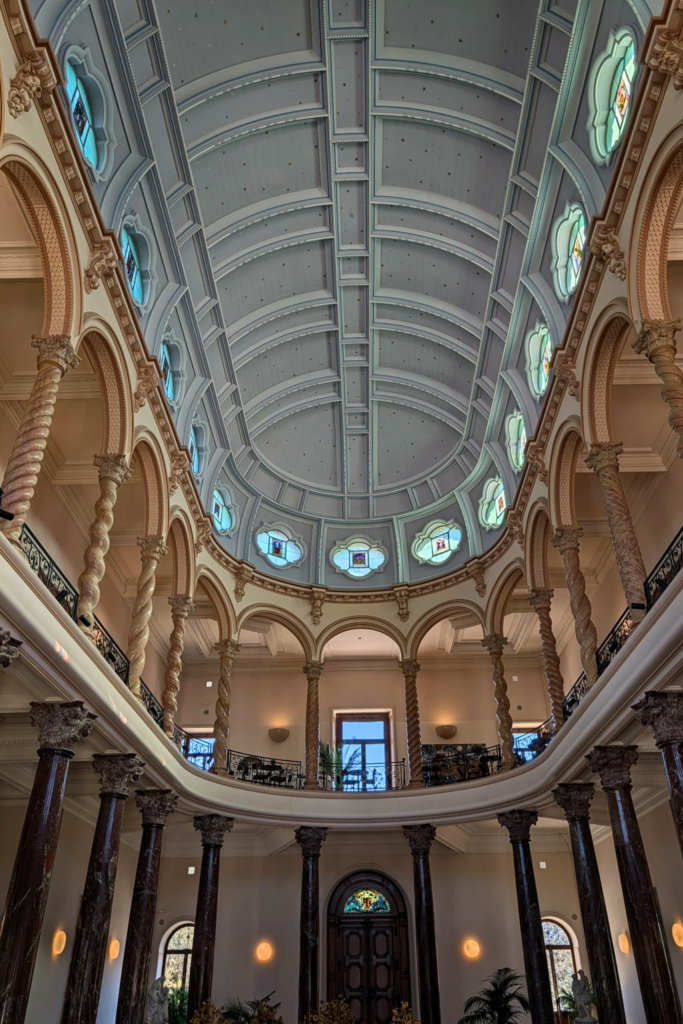
I’ve always found the entrance of Musée Ariana spellbinding — two stories of porcelain artwork framed by marble pillars, drawing the eye upward to a Tiffany-blue ceiling. Stepping outside one of the world’s most extensive collections of historic ceramics and glass, visitors can catch a glimpse of a Japanese-like spring in the surrounding Parc de l’Ariana.
In the warmer months, a small pathway leads through a cluster of Japanese cherry trees, gifted in 2014 by the Japan Club of Geneva to commemorate 150 years of diplomatic ties between Japan and Switzerland. The park is made even more memorable by the replica Buddhist bell nearby, which carries an extraordinary story.
Lost from a temple in a town near Tokyo in 1867, the original bell was purchased by collector Gustave Revilliod, founder of the Ariana Museum, before its origins were fully understood. Once its provenance was later identified by diplomats at the nearby League of Nations, recognizing the bell from the listed names of generals written in Japanese, the bell was returned to Japan in 1930. Sixty years later, the temple presented an exact replica to the city of Geneva as a gesture of gratitude.

Leave a Reply