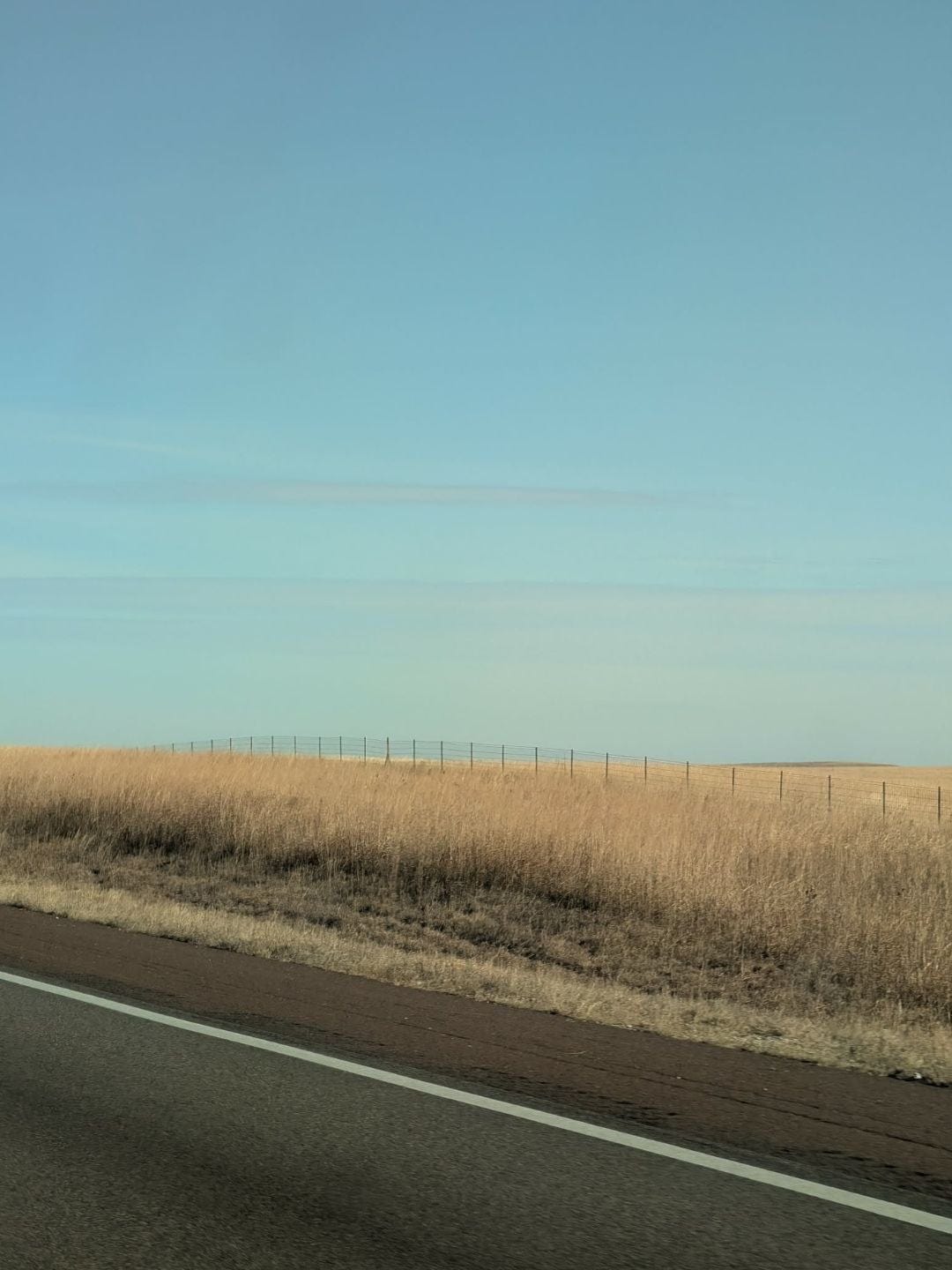
“I thought his butter had slipped off his toast!” my dad said as we drove alongside plains in Kansas, his eyes wide in his gift for storytelling, in-between crunches of banana chips. Our stash of snacks for the 9-hour drive was piled high from Buc-ee’s gas station finds – butternut pecans, Oreo cookie fudge, oily potato chips – all healthy, Dad said, because it was homemade. Buc-ee’s was an adult Disneyland in red states – selling everything from tornado shelters to deer feed.
After two years in our cozy apartment in Switzerland, I was nervous to return to the U.S. given horrific stories about ICE and uncertainty of what to expect at border control. I had lived in Boston during President Trump’s first mandate in 2016, yet this second surge of power had shaken up the world order at an unprecedented pace. Many of my friends and family still do not feel safe expressing their political opinions, while others praise lower gas prices, and feel the economy is improving.
I never was one to believe that America required treading backwards to be great – but rather to evolve. In my wildest dreams, the United States would take inspiration from Switzerland, equipping itself with the following:
- Reliable trains that connect faraway cities
- Accessible sidewalks
- Renting not treated as a personal failure
- Protected mealtimes
- Generous maternity leave
- Quiet Sundays
Reliable trains that connect faraway cities
Our small town in Iowa did not have a large grocery store nearby, save for the convenience shop stocked with homemade jam and slowly churned butter run by the Brethren. If any activity exceeded the U.S. postal service or soft serve ice cream, a car was required.
It’s been 15 years since I’ve driven a vehicle, spending most of my 20s in France, Boston, and relocating in 2018 to Switzerland. I often wonder if I should take driver’s ed again to keep up the skill if ever needed, or if I should just come to terms with A.) I dislike driving (or even being a passenger, for that matter) and B.) I live in a part of the world where a reliable transportation system exists.
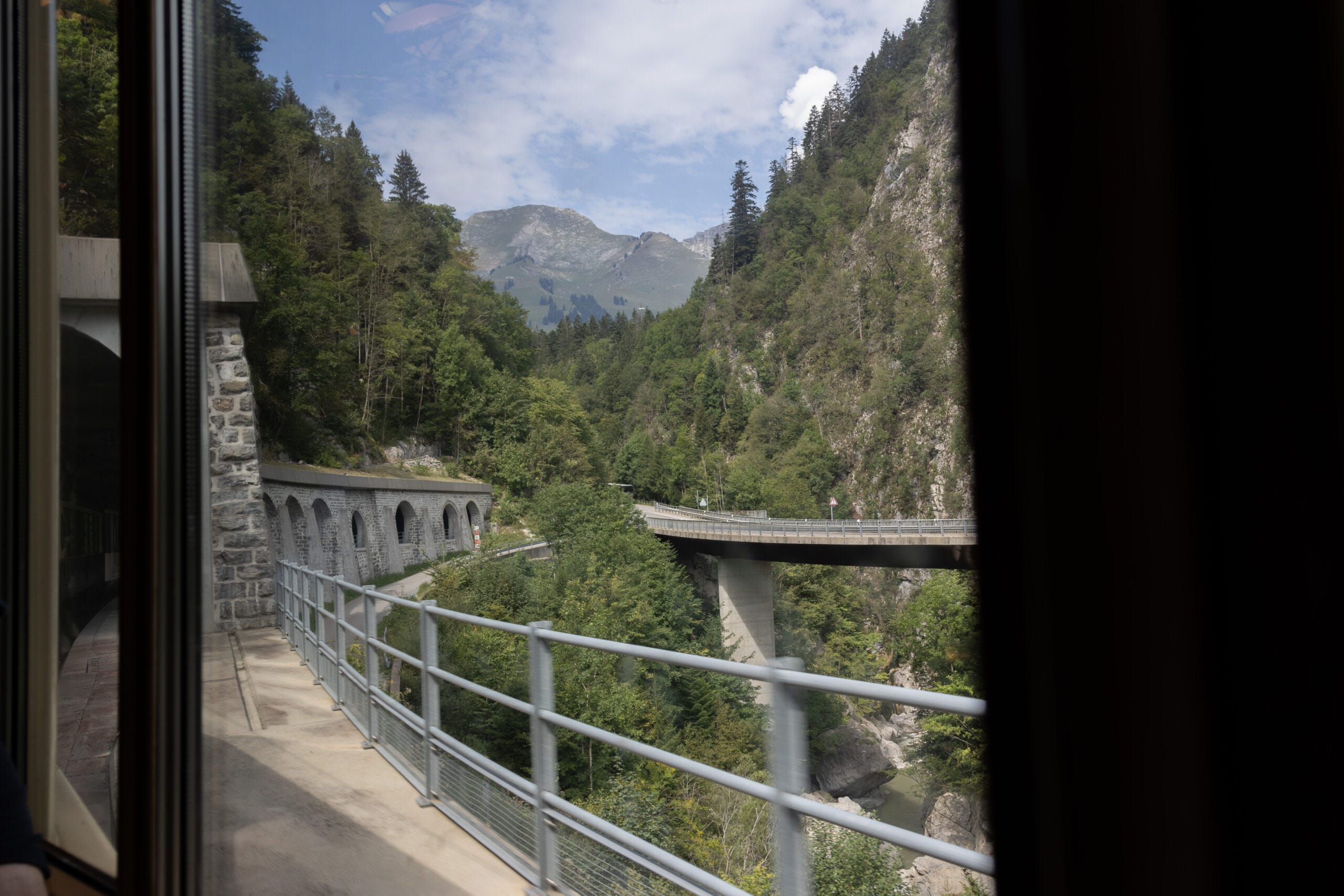
I romanticize train travel – even going so far as to journey 13 hours in a night train between Prague and Zurich. While I feared being flung out of the small compartment bed during the night, it was nevertheless exciting to fall asleep to the sound of the locomotive moving along the rails, waking up to an unexpected knock on the door with a tray of fresh coffee as we crossed the border into a new country.
To be fair, the United States was once king in its use of passenger trains. However, with the invention of the automobile, the government encouraged states to invest in highways. Many cities that exist today were constructed for vehicles.
Passenger trains exist today through the country’s sole passenger rail travel provider – Amtrak. Journeys on Amtrak are far from the high-speed trains across Europe and Asia, often journeying 40-to-50 hours across long stretches of land. Amtrak’s 46-hour Empire Builder from Chicago to Seattle, passing through Montana’s Glacier Park, is high up on my list, as well as viewing the Pacific coastline aboard Amtrak’s California Zephyr.
Accessible sidewalks

As a species, humans have walked from the beginning of our evolution. Despite this innate human act, studies show that Americans continuously walk less than those in other parts of the world. This is of course dependent upon city, walking in Manhattan as opposed to Tuttle, Oklahoma or Waterloo, Iowa will greatly vary.
As with trains, cities in the U.S. were built to accommodate vehicles. According to a 2025 article in National Geographic, 92% of U.S. households have one vehicle or more, and only 6.8% of the population lives in a highly walkable area.
Walking in Middle America is challenging if outside a park or city center. It can also prove dangerous with 7,314 pedestrians killed by vehicles nationwide in 2023 according to the U.S. Department of Transportation, or 20 pedestrians killed every day by vehicles.
Renting not treated as a personal failure
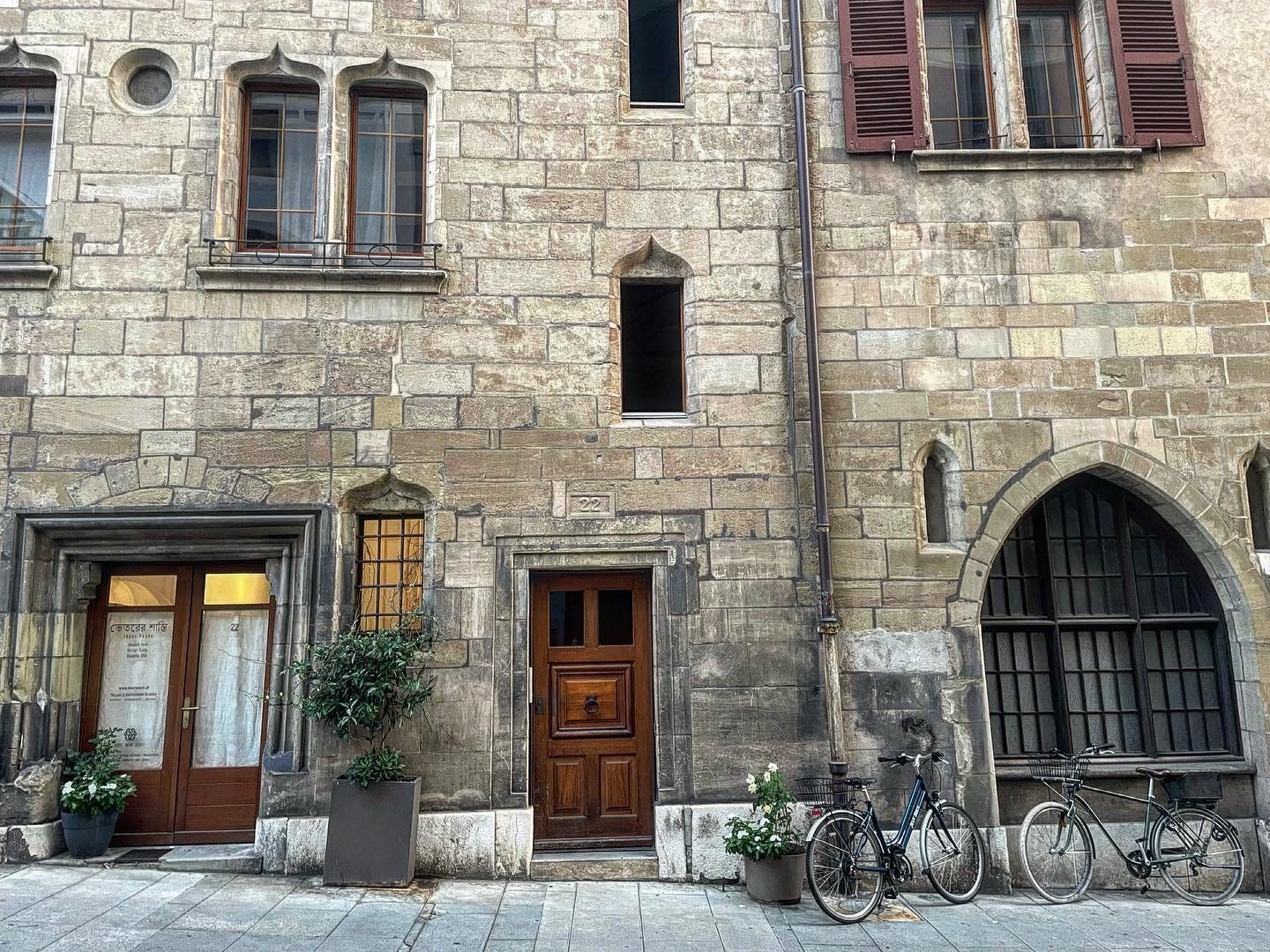
Home ownership in the U.S. is viewed as attaining the “American dream”. In Switzerland, my Swiss husband and I happily rent. While we cannot tear down walls or retile without permission from our landlord, we feel secure in that if there is a leaky ceiling, termites, or electrical conundrum, this is not our problem.
While renting may be seen by some as throwing money out the window, I’ve always viewed it as freedom – unchained from the phantom costs and unexpected mishaps that property can provide. My Swiss in-laws, now in their 70s, have rented their entire lives for a similar reason – the price to pay for home ownership in Switzerland is astronomical, often soaring far above CHF 1 million. It is for this reason that many Swiss turn towards neighboring countries to invest in real estate.
Protected mealtimes
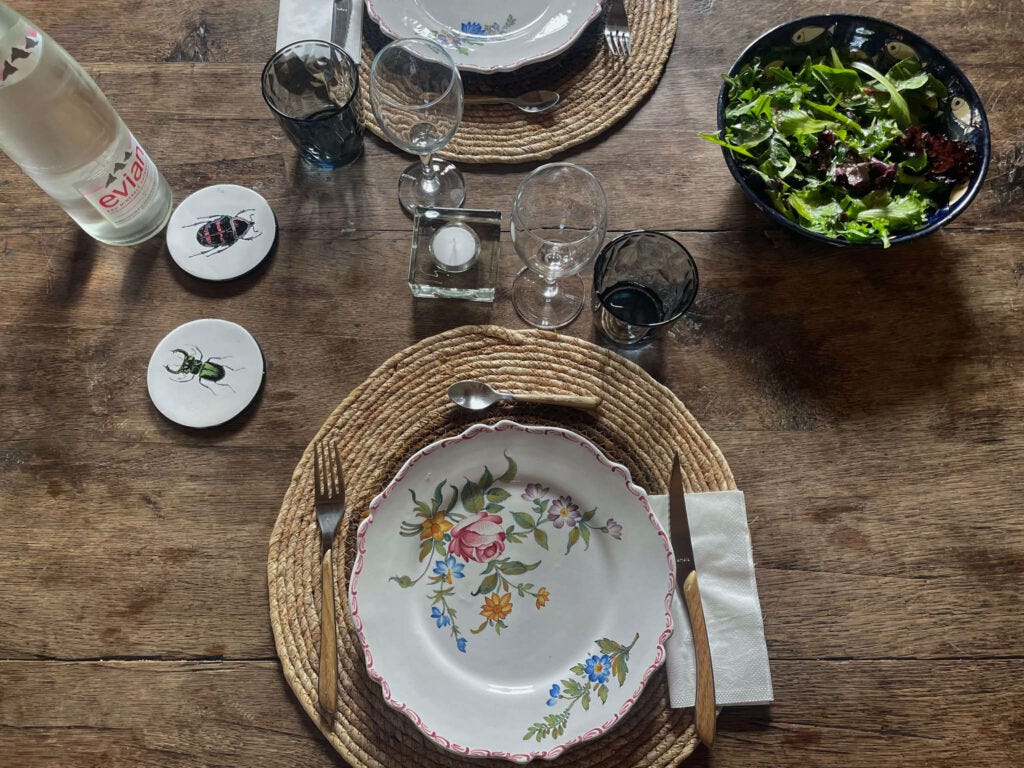
If there is one aspect of life that significantly impacted me after moving abroad, it was eating.
The U.S. is extreme in defining areas of good and evil – whether that be cowboys versus Indians, Republicans versus Democrats, heaven and hell – and even bad carbs versus good.
In Switzerland, chocolate is more than food – it’s an art. Eating chocolate should be cherished- and is never deemed as “bad”. Instead its eaten in moderation, preferably concluding an hour-long meal and splashed down with coffee.
Meals times are sacred, meaning that you cannot easily find restaurants open outside of lunch hours (12:00 p.m. – 2:00 p.m.) or dinner (7:00 p.m. – 10:00 p.m.). Aside from fast food chains, most restaurants are also closed on Sunday.
I do believe that organized mealtimes help to regulate our systems. Studies show that organized mealtimes even decrease the chance of obesity, type 2 diabetes, and cardiovascular diseases.
Generous maternity leave
I remember my first corporate job outside of college – working the night shift at a John Deere call center, where I helped French-speaking farmers located in France, Belgium, and (oh golly, even Quebec, which my untrained ear had trouble to advise!) in reprogramming tractor equipment. My then 22-year-old self knew very little about farm equipment, and most of my advice consisted of “Did you turn it off and back on again?” which often worked like honey on a dry throat.
What shocked me most about this 3-month position was not the vampire-like lifestyle I adopted, eating breakfast at twilight or dimming the lights mid-afternoon to sleep, but rather a co-worker who returned to work three days after giving birth.
“We need the money,” she shrugged meekly, slipping her headphones on.
In the United States, there is no federal law that requires paid maternity leave (while some companies or states may offer this), whereas Swiss law demands it.
While working mothers in America often return to work 2 – 6 weeks later, working mothers in Switzerland are entitled to 14 weeks of leave, receiving 80% of their previous annual earnings, subject to a maximum of CHF 220 per day.
I can only imagine how much stronger society would be if mothers were given a true safety net—one that allowed them to parent without the constant fear of financial instability. As if childbirth weren’t demanding enough, many women are then faced with the pressure to return to work quickly, to parent flawlessly, and to appear “put together,” all while adjusting to a new body, a new life, and, for some, navigating postpartum depression.
Quiet Sundays

Resting on Sunday isn’t only encouraged in Switzerland, it’s the law.
In Switzerland, one can be fined for mowing a lawn or recycling on Sunday, as it is seen as a noise disturbance to those nearby. Depending on apartment regulations, noise should also be reduced after 10 p.m. on weeknights, including taking shows or flushing toilets.
What was once a day to stock up on groceries and run other errands is left to other days in the week, as all shops are closed throughout the country, besides a few fast-food chains. I found this a hard pill to swallow moving here eight years ago, however this has now become my favorite ritual of the week – allowing the world to be quiet, silently recharging, ready to take head- on whatever it is that Monday decides to bring.